Watch a case run
The diagnostic problem every workshop has

You have a method.
It just lives in your head.

It starts from nothing on every job, it forgets what you ruled out an hour ago, and it can't be handed to anyone.

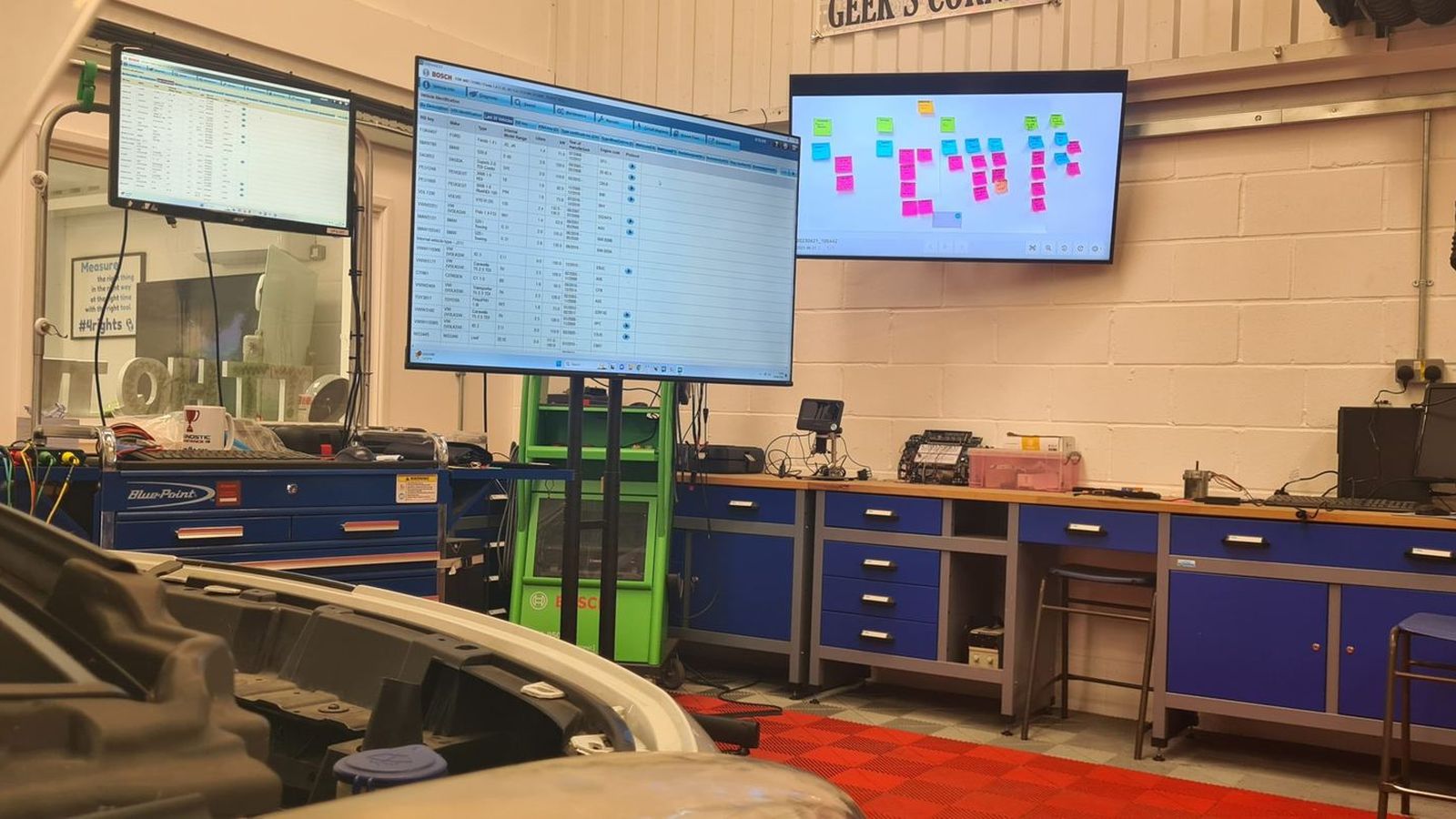
DAVO is where it lives instead. Not a scan tool, and not a replacement for one: it sits alongside whatever you already use and holds the reasoning while you work. Every failure mode for the system in front of you, authored by people who have seen it fail, ordered so you test what eliminates the most.

£callper technician, per month
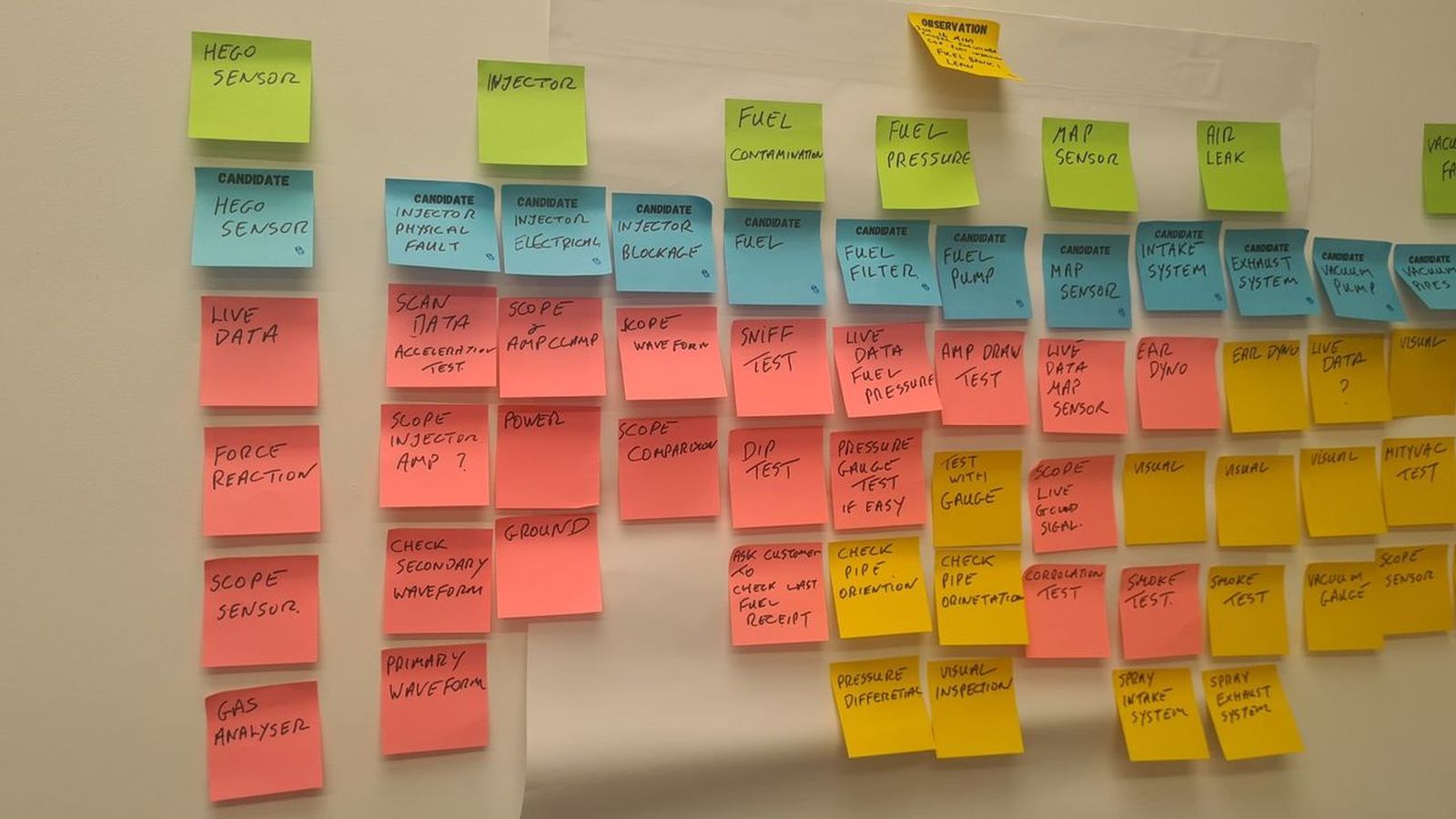
A board covered in colour-coded sticky notes laying out a diagnostic case
The 4Rights® method, before it was software.
2014EuroSkills gold, Automobile Technology, Lille
2015WorldSkills Medallion for Excellence, São Paulo
11 yrsTop Technician placings, every year from 2014 to 2025
22,000+Technicians, diagnostic technicians and master technicians trained in the method since 2004
Where the money goes

The call all garages dread.

The car is back, the customer is calmer than you would like, and the invoice for the part you fitted last week is sitting on the counter. Somebody has to explain what the four hours they paid for last week actually bought them.
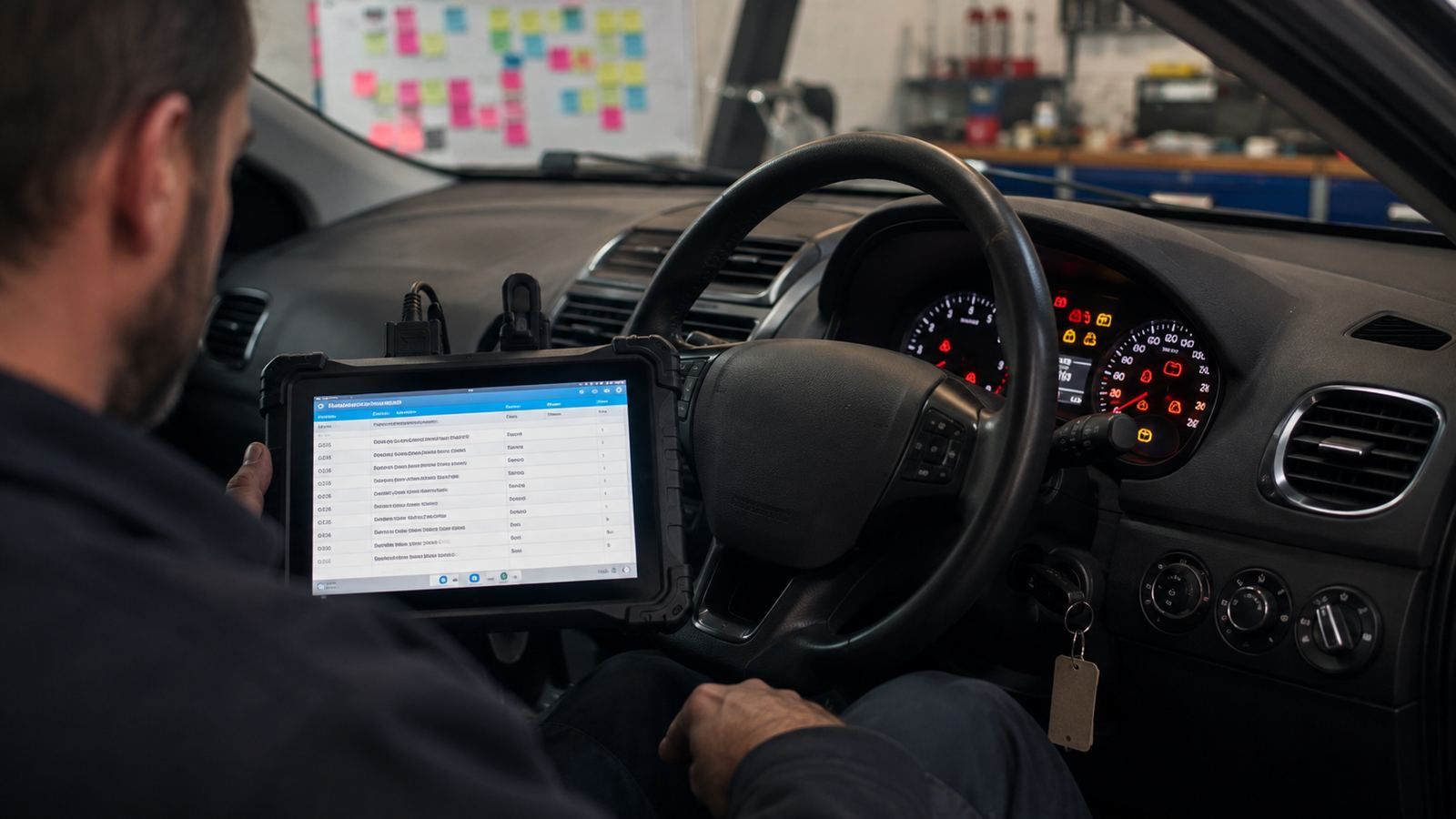

The car presents the problem

Warning lights, fault codes, symptoms, complaints. All of it arrives at once and none of it is an answer. They are simply clues to the root cause.

The car gives you observations.
A technician in the driver's seat reading a fault code list on a diagnostic tablet

The problem space expands

One client complaint can support many possible explanations. Every one of them is plausible. None of them is proven. That’s the job of the technician.

Many possibilities. None proven.

Pressure arrives

Time is limited, costs add up, and the customer expects an answer today. The pressure often causes the decision to get made before the evidence has been gathered.

Diagnosis happens under pressure.
A technician on the phone writing on a job sheet in a busy workshop, a customer waiting in the doorway

Bias takes hold

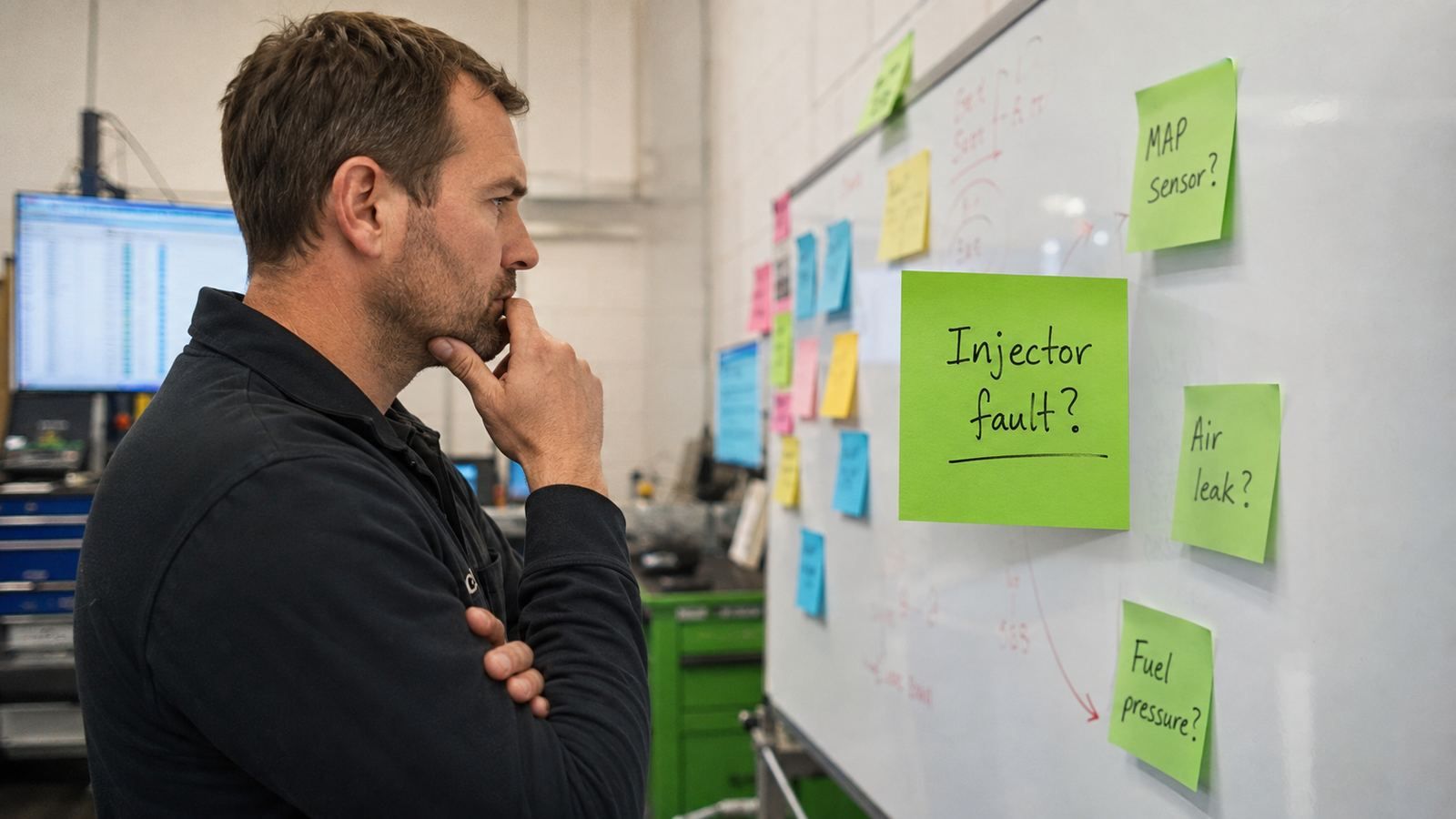
One hypothesis starts to feel more convincing than the others. It is usually the one you have seen before. Or mentioned in a TSB. Your view narrows even before the testing starts.

Plausible can start to feel proven.
A technician looking at a whiteboard where one note reading Injector fault is underlined and larger than the others

Reset: externalise the case

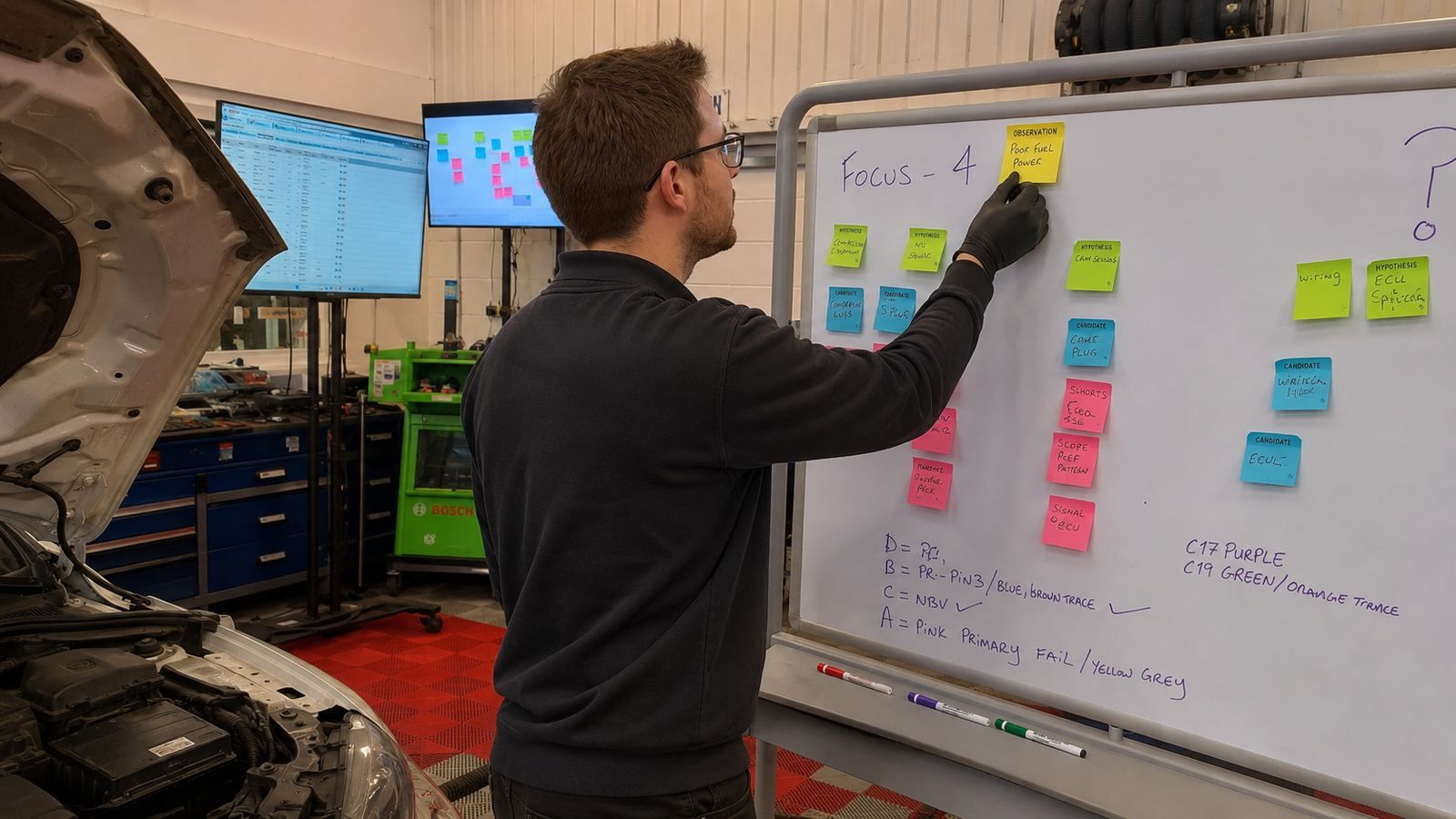
Stop guessing. Write the observation on a note and put it where you can see it. The first step toward certainty is analysing the data and not choosing an early answer.

Externalising creates clarity and keeps thinking honest.
A technician placing a yellow observation note at the top of a whiteboard

Make the thinking visible: the tree

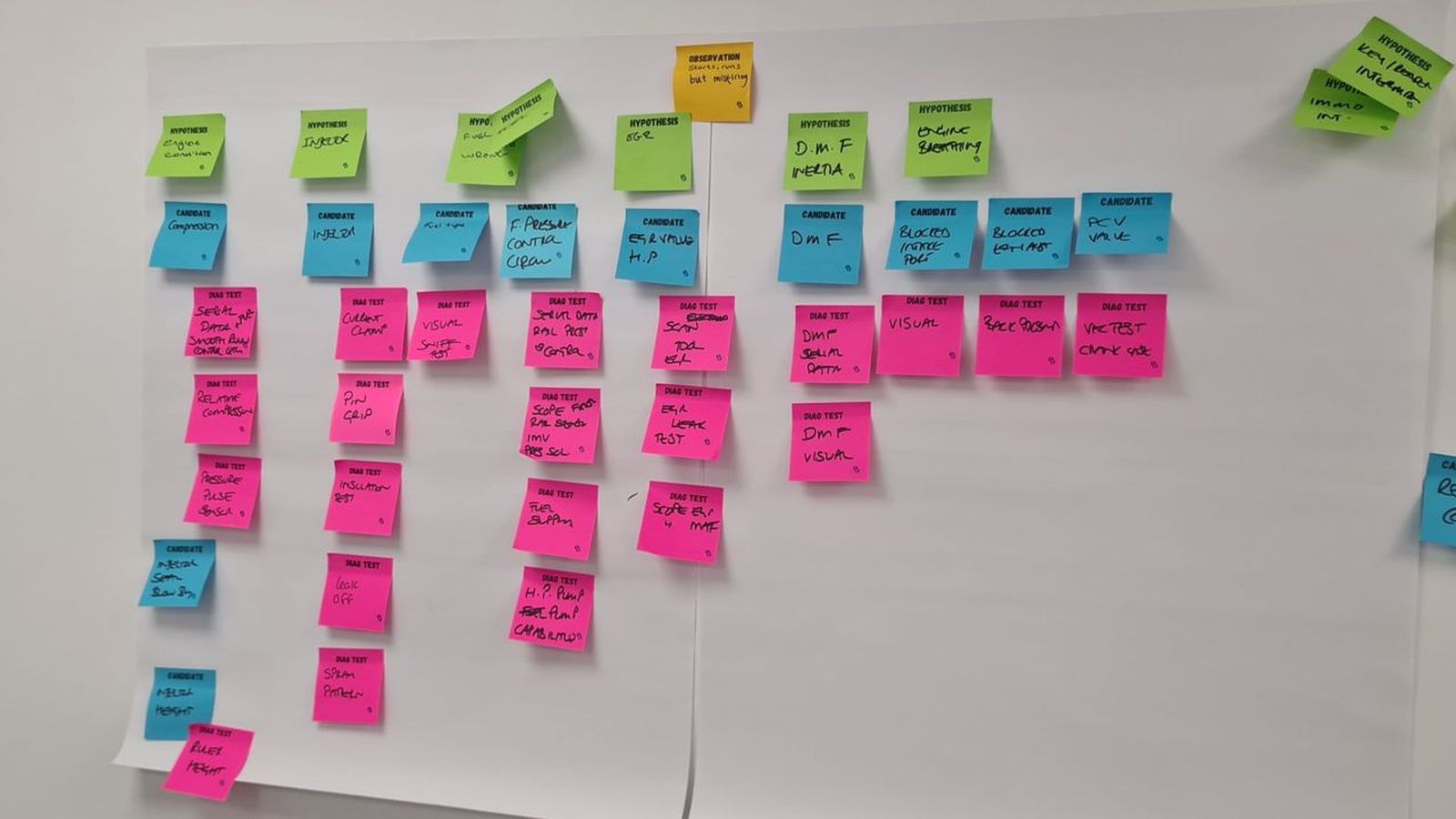
Hypotheses fan out across the top. Under each hypothesis sit its own candidates, and under each candidate its own diagnostic tests, descending downward. A column is one possibility with its own descent, not a stage that everything passes through.

The real sticky-note method

This is how it looks in real life. Messy. Worked. Honest. We ran this system for years on unfixable problems and on diagnostic training courses.

The problem is now outside the technician's head.
A real course board: one observation note at the top, hypotheses fanning out beneath it, candidates and tests descending under each

The case acquires state

The case remembers the current stage the diagnosis has got to. What is open, what has been tested, what still needs evidence. Nobody has to reconstruct it again after a coffee break or interruption.

Evidence removes possibilities

Run a test that refutes a hypothesis and the whole branch comes off the board: the hypothesis, its candidates and its tests, together. Diagnostics – proving what is NOT the problem item. One result clears an entire region of possibility. Repeating this process removes possibilities until only the root cause remains.

The transformation

The physical method becomes digital structure

The notes flatten into tiles. No colour translation. Only the geometry changes. Same colours, same meaning, new representation.

Without a method
still open, 0:00
Wandering search. No durable progress.

The five layers of a DAVO case

  • Observations: the symptoms a technician can search for and recognise on the vehicle.
  • Hypotheses: every authored failure mode that could be to blame, ordered by what eliminates the most.
  • Elements: the components implicated once a hypothesis is chosen.
  • Characteristics: defined tests on that one element, each authored against the 4Rights®.
  • Expected value: one criterion, failed. The case resolves to a root cause.
A method, made into software

DAVO is a reasoning framework that holds the diagnosis open, which frees you to do the thinking.

Not a fault code database. Not a flowchart. Not a TSB database.

Every failure mode for that system is already written down, by people who have seen it fail. The technician describes the symptom and the possibilities come back ranked, all of them, not the ones they happened to remember. They choose which to pursue, work down to a specific test, and take the reading. The hypothesis survives or it is eliminated.

Why flowcharts fail

A flowchart is somebody else’s diagnosis, written before they met your car.

It only catches the faults its author thought of. The one in your bay is rarely on that list. DAVO lets you keep the judgement open and remembers your reasoning.

Recorded by default
100%

of eliminations captured as you make them.

The four hours

“So what did the four hours buy me?”

Every test you ran, what you expected, what you read, and what it ruled out. Written while you worked, not reconstructed at the counter.

Ruled out

Most of diagnosis is proving what it isn’t.

But usually none of it gets written down. Four hours of ‘time spent’ shows as four hours of nothing to show for it.

Handover

Evidence, not your word for it.

Anyone can say they checked it. You can show which tests said so.

4Rights®

The diagnosis is wrong because one of your 4Rights® isn’t.

Get one wrong and the reading cannot be compared to anything. Most bad diagnoses are not bad reasoning. They are a good reading taken under the wrong conditions, compared against a value that assumed different ones.

A workshop wall painted with the four rights: measure the right thing, in the right way, at the right time, with the right tool
1Measure the Right ThingThe correct component, and the correct signal from it.
2In the Right WayThe correct connection point.
3At the Right TimeThe correct operating condition. Key off, key on engine off, cranking, running.
4With the Right ToolThe correct instrument for that measurement.

Every test carries its own criteria, authored for that component, in the right state, at the right point, with the right tool. Nothing is inherited from a general case.

Built for independent workshops

Garage owners

The workshop others send the difficult ones to.

You stop absorbing the cost of work nobody can account for, and you stop having the conversation where the honest answer is that you are not sure what went wrong.

Experienced technicians

The structure does the bookkeeping.

You concentrate on the reasoning, and your eliminations are captured as you make them.

Developing technicians

The part that takes fifteen years to build in your head already exists.

So the learning happens on the reasoning rather than on recall.

What it costs

£call per technician,
per month.

Compare it to a comeback rather than to a diagnostic.

A comeback costs you the labour twice, the part you already fitted, the slot in the diary you cannot now sell, and a customer who tells other people about it. The monthly subscription is great value by comparison.

Questions

Before you ask.

Does it replace my scan tool?

No. It sits alongside whatever you already use. Your scan tool reads the vehicle; DAVO holds the reasoning about what the readings mean and what to do next.

What do I need to run it?

A browser. It runs on the workshop PC, a tablet on the bench, or a phone. Nothing to install. The learning is done online, in your own time, with a call to get you started.

Is it per technician or per site?

Per technician. Each person gets their own login, because the case history follows the person who worked it. Groups, networks, factors and colleges buy blocks of seats and allocate them, which is a different conversation: six different reasons to pay for it.

How long before it is useful?

The first case. There is nothing to install, no configuration and no data to import. What takes the effort is the method, so every licence includes an onboarding call, the e-learning, and regular remote workshops.

Who wrote the content?

People who have seen the failure modes and flowcharts fail. It is authored by experienced subject matter experts.

Start with one case.

The quickest way to judge this is to watch it work on a fault you recognise.